

Originally authored By Dr. Allison Smith, ZRT Laboratory. Reproduced with permission. Last reviewed: May 2026.
Starting a regimen of iodine supplementation should be based on a detailed nutritional, physical, and laboratory assessment. Once the need is established, some clinicians go straight for supraphysiologic dosing while others may implement a diet rich in sea vegetables to get the job done. How do you decide where to start? The first step is understanding the different supplement forms of iodine.
Understanding Iodine Supplementation Forms
Iodine exists in several oxidative states in the body which perform vastly different actions. A working knowledge of these forms is needed before diving into testing the markers of iodine status — because as those markers inform the course, the form and dose will determine the outcome.
Iodide (Potassium Iodide)
You'll find it in supplements typically as potassium iodide (KI). Iodine, in the form of iodide, concentrates in the thyroid gland and any other tissue with the right sodium iodine symporter (NIS) protein to bring it in — NIS concentrates iodide not only in the thyroid, but also in the cervix, the ovaries, placenta, eyes, skin, and lactating breast. This is the form of iodine that gets incorporated into thyroid hormones which transport iodine around to the entire body by T4 to T3 conversion intracellularly, thereby supporting a myriad of processes from basal metabolism to ovulation to the immune system. So, if you're looking to support the thyroid and its T3 and iodine delivery service, KI may be a good choice.
Dosing range is typically 150 µg – 1,100 µg (0.150 mg – 1.1 mg) daily.
I₂ (Molecular Iodine)
Quite different from iodide, I₂ (molecular iodine) passes into body tissues in a NIS-independent fashion by facilitated diffusion. It lends more of an antioxidant, anti-proliferative effect to tissues by virtue of its structure and ability to form protective iodolactones and iodinated lipids — rather than concentrating in only the NIS-rich tissues as iodide would. You'll notice when you read the label of any "molecular iodine" supplement that I₂ is supplemented as a mixture of potassium iodide (KI) and iodate (KIO₃) or potassium iodide and free iodine.
Once absorbed, some studies show I₂ doesn't affect thyroid markers (which is good news for some patients) but does enter the breast, the prostate, tumour sites, and cystic areas, acting at the mitochondrial level to attenuate benign and cancerous growths. So, this is the form to use when attempting to avoid thyroid uptake and to push the reactive oxygen species (ROS) scavenging and cell cycle-limiting effects of iodine in other parts of the body.
Dosing range is typically 1,100 µg – 12,500 µg (1.1 mg – 12.5 mg) daily.
*Supraphysiologic dosing is anything over 1,100 µg (1.1 mg), although a 2013 paper exploring extrathyroidal actions of iodine recommended at least a 3 mg daily intake of I₂.
Here are some examples of such forms currently available to patients — this is in no way an exhaustive list, just an idea of what's out there.
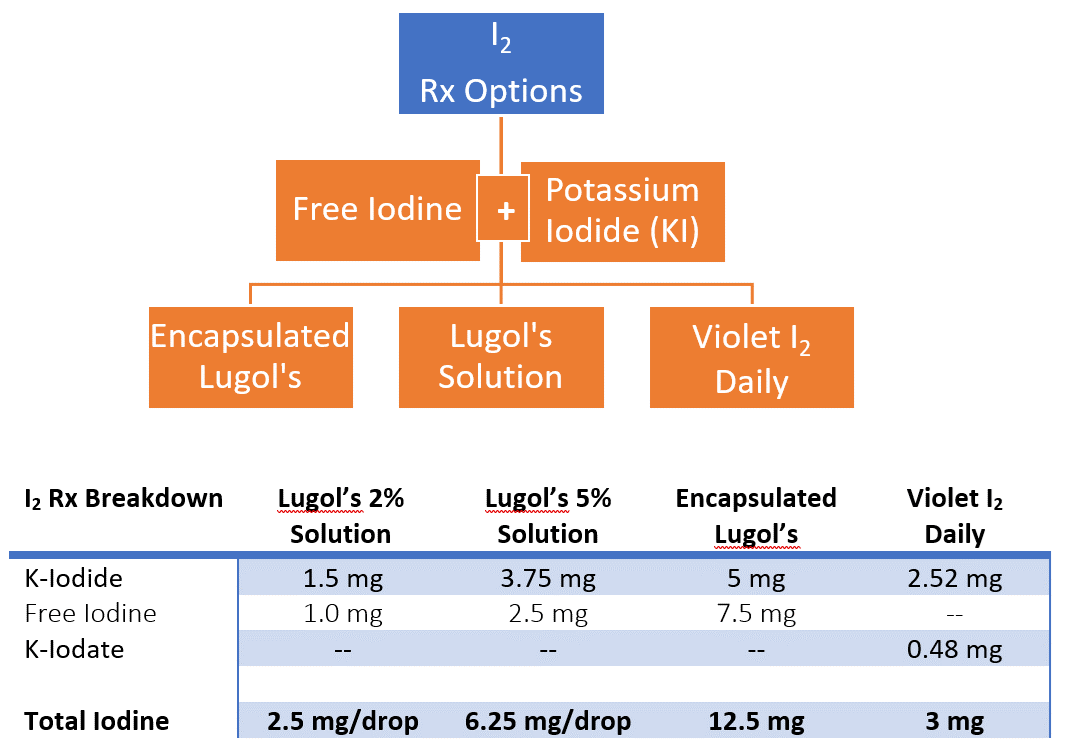
Caveat(s): It is possible that any of the iodine Rx options listed above will have some iodide effect on the thyroid and caution should be exercised even with the ones that claim 100% conversion to I₂. When supraphysiologic doses are used (even transdermally), urinary iodine excretion skyrockets into the thousands. For instance, with a 12.5 mg dose, expect to see lab results between 1,000 and 3,000 µg/g Cr. For sufficiency, the normal laboratory range for general thyroid health is 100 – 380 µg/g Cr.
Monitoring Iodine Therapy with At-Home Testing
Whichever form of iodine you choose, ongoing monitoring is essential to ensure safety and efficacy. The most direct way to track urinary iodine levels at home is with a dried urine iodine and creatinine testing kit — a simple, accurate method that avoids the interference issues associated with traditional ion electrode testing. Pairing this with a Free T4 blood spot test allows you to track how thyroid hormone production responds to supplementation over time.
Iodine Supplementation and Hashimoto's Thyroiditis
When anti-thyroid antibodies contribute to thyroid dysfunction, recommending iodine supplementation may feel like a dangerous undertaking. Many providers don't recommend it at all. As a matter of fact, it's not uncommon to see someone with Hashimoto's have urinary iodine labs in the severely deficient range of less than 30 µg/g Cr. That said, there are some providers treating autoimmune thyroiditis with mega-doses of molecular iodine — sometimes upwards of 100 mg per day. And amazingly, these doses don't seem to put the average patient's thyroid into a storm, and some case reports tout complete resolution despite the inherent risk.
It makes good clinical sense to ensure that even autoimmune patients receive properly monitored nutrition for their thyroids and the rest of their iodine-sensitive tissues. The supplemented form should be mostly molecular iodine to minimise the impact on thyroid hormones and keep the thyroid as quiet and happy as possible. Using thyroid hormone prescription to keep TSH within the normal range (NOT LOW!) ensures the NIS system will still be working hard to bring nutritionally acquired iodine into the body tissues.
Dosing range is conservative with frequent monitoring: 150 µg – 1,100 µg (0.150 mg – 1.1 mg) molecular iodine, with the general rule of start low, go slow.
Final Thought: Support and Thwart
Iodine performs some crucial roles in the body within multiple systems but it never acts alone. Depending on the environment, iodine can oxidise, reduce, and form complexes. Without stacking the deck in favour of reduction, too much iodine in the body can be destructive and may even increase the risk of autoimmune thyroiditis. Once you identify low iodine status in an individual, it is absolutely imperative to assess and support iodine's equal partners — selenium, iron, magnesium, zinc, B6, cortisol, glutathione — and consciously work to identify and thwart the endocrine disruptors like bromine, cadmium, mercury, and arsenic in order to get the best outcome.
Not sure if you have iodine deficiency? Read our guide on how to assess iodine deficiency before starting any supplementation protocol.